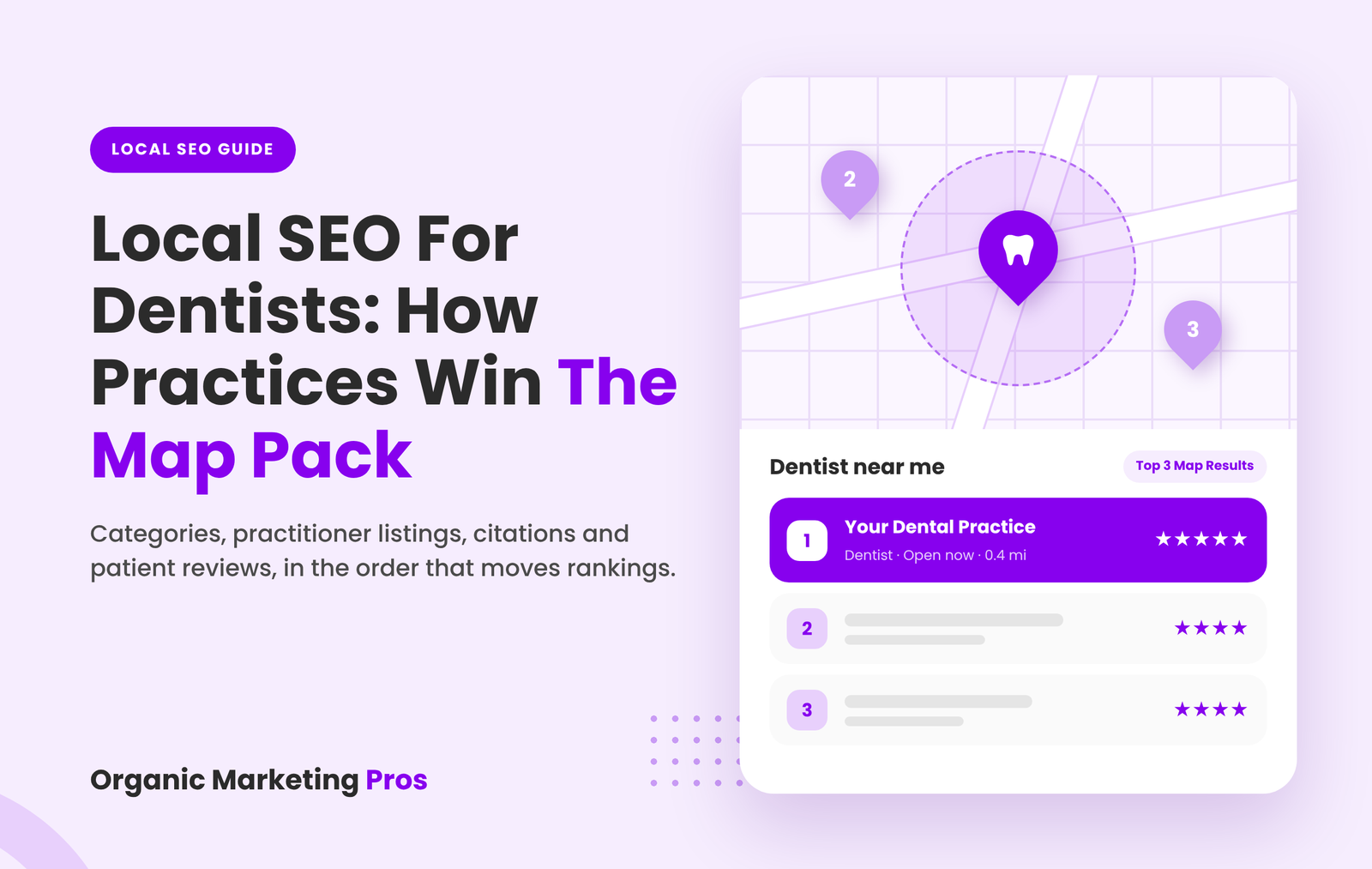
Local SEO for dentists is the work of getting your practice into the three Google Maps results that appear when someone nearby searches “dentist near me” or “emergency dentist”. The practices that win usually do four things well: they pick the most specific Google Business Profile category, keep their name, address and phone number identical everywhere, earn a steady stream of recent patient reviews, and back the profile with a website that has a page for each treatment and location. Distance from the searcher matters too, and you can’t change it, which is why the other three levers matter so much.
This guide walks through local SEO for dentists lever by lever, in the order we’d fix them, including two problems most guides skip: practitioner listings that quietly compete with your practice, and review replies that can break HIPAA. If you want the general version for any business first, our local search optimization guide covers the basics. If you are deciding who should do this work, start with how to choose a dental marketing company.
How Google Picks The Three Dentists In The Map Pack
Relevance, Distance And Prominence
Google says local results are based mainly on three things: relevance (how well your profile matches the search), distance (how far you are from the searcher or the location in the query) and prominence (how well known your practice is, from reviews, links and mentions across the web). Google also says complete, accurate profile information helps you match more searches, and that you can’t pay for a better local ranking (Google Business Profile Help).
That last point is worth repeating to anyone selling “guaranteed” results in local SEO for dentists. Map pack positions for dentists come from those three signals, and they shift with every searcher’s location.
What Local SEO Experts Rank Highest
Whitespark’s 2026 Local Search Ranking Factors survey asked experienced local SEOs to score 187 factors. For the map pack, the top three were the primary Business Profile category, proximity to the searcher, and keywords in the business name. On the negative side, an incorrect primary category scored almost as high as being marked permanently closed, and other profiles in the same category at the same address ranked third, a problem we cover below (Whitespark ranking factors).
These are expert opinions, not Google’s weightings, but they match what most practitioners see. They also echo the wider picture in our guide to Google ranking factors.
Set Up Your Dentist Google Business Profile Correctly
Your dentist Google Business Profile is where most gains in local SEO for dentists come from, and it is the fastest place to see change. It is also the heart of any local SEO services engagement, so if you only fix one thing this month, fix this.
Pick The Most Specific Primary Category
In local SEO for dentists, the primary category is the single biggest setting: it tells Google what your practice is. For a general practice that is “Dentist”. A specialty practice should use its specialty: “Orthodontist”, “Pediatric dentist”, “Endodontist” or “Periodontist”. Whitespark’s study of 1.8 million profiles found that a specific primary category correlated with about 36% more presence in the top 10 results than a generic one (Whitespark Q3 2026 roundup).
Additional Categories For Your Treatments
You can add up to nine additional categories, and Whitespark ranks them as the eighth most important map pack factor (Whitespark categories guide). Add only what you genuinely offer, for example “Cosmetic dentist”, “Emergency dental service”, “Dental implants periodontist” or “Teeth whitening service”. Check the exact names in your profile, since Google’s list changes. Adding unrelated categories creates “category confusion”, which the same survey lists as a negative factor.
Use Your Real Practice Name
Keywords in the business name correlate strongly with rankings. In Whitespark’s 2026 study, medical and health listings with an exact match keyword in the name reached the top three about 9.6% of the time, against 2.9% without one (Whitespark business name study).
We still tell dentists not to add “Best Dentist Houston” to their profile name. Google’s guidelines say the name must match your real world name as used on signage and stationery, and adding unnecessary keywords is not allowed (Google Business Profile guidelines). Competitors can suggest edits, and a suspended profile costs far more than the ranking lift. If you are opening a new practice or rebranding, a descriptive name is a legitimate choice. Stuffing an existing one is not.
Practitioner Listings: When Each Dentist Gets A Profile
Google allows individual practitioners, such as dentists, to have their own profiles. Its guidelines say a practice with several public facing dentists should have a profile for the practice location separate from each dentist’s profile, while a solo dentist representing a branded practice should share one profile with the practice (Google Business Profile guidelines).
Practitioner profiles are the most overlooked part of local SEO for dentists, and many practices don’t know they exist. Google can create them automatically from public data, so a dentist who left three years ago may still have a profile pointing at your address and phone number.
How The Same Category Filter Hides Listings
When several profiles at one address share the same category, Google usually shows only one of them for a given search. Whitespark’s survey ranks this filter as the third most damaging negative factor (Whitespark ranking factors). The result: your practice profile and your lead dentist’s profile compete, and the weaker one can be the one that shows.
What to do: search Google Maps for each dentist’s name, claim every practitioner profile, ask Google to mark profiles of departed dentists as moved or closed, and link practitioner profiles to that dentist’s bio page rather than your homepage. Decide which profile should carry your main category and focus your review requests there.
Complete Every Field Patients Use
Whitespark found that moving from 0 to 5 on its profile completeness index improved average rank by about 19 positions (Whitespark Q3 2026 roundup). In local SEO for dentists, that means hours (including holiday and emergency hours), services with short descriptions, accepted insurance where the profile offers it, accessibility and language attributes, a booking link, and real photos of the team, rooms and building entrance. Missing hours alone is a known negative factor.
Build Dental Local Citations That Match Everywhere
A citation is any listing of your practice name, address and phone number (NAP). Dental local citations are a quieter part of local SEO for dentists: they confirm to Google that your profile data is correct, and Whitespark’s 2026 report says citations still matter, especially listings on industry relevant sites (Whitespark ranking factors).
Where A Dental Practice Should Be Listed
Start with the platforms that feed maps and AI assistants: Apple Business Connect, Bing Places and Yelp. Then add healthcare directories patients use, such as Zocdoc, Healthgrades and WebMD, plus your state dental association, local chamber of commerce and any insurance network directories. Quality beats volume. Fifteen accurate listings do more than 200 inconsistent ones.
Call Tracking Without Breaking Your NAP
Dentists often swap in tracking numbers for ads and directories, then find a dozen phone numbers floating around the web. Mismatched NAP and tracking numbers across the data ecosystem are on Whitespark’s negative factor list. The safer setup: keep your main number as the primary phone everywhere, and if you use a tracking number on your Business Profile, put it as the primary and your main number as the additional phone. Coordinate this with whoever runs your PPC management so ad numbers never leak into listings.
Patient Reviews: Volume, Recency And Safe Replies
Patient reviews do double duty in local SEO for dentists: they lift prominence and they decide whether a searcher calls you or the practice next door. Whitespark’s survey ranks review recency 11th of 187 map pack factors, so a practice with 400 reviews and none this year can lose to one with 90 recent ones.
A Simple System For Asking Every Patient
Ask every patient, not just the happy ones. Send a short text or email with your direct Google review link within a day of the visit, and have front desk staff mention it at checkout. The FTC’s 2024 rule bans buying reviews, writing fake ones and suppressing negative ones (FTC), and Whitespark lists review gating as a negative ranking factor. Never offer discounts for reviews. If you want help running this across locations, see our guide to online reputation management services.
Reply Without Confirming Anyone Is A Patient
This is where dental practices get fined. Replying to a review with details of the person’s treatment, or even confirming they are a patient, can be a HIPAA disclosure. One Texas practice paid $10,000 to settle after replying to reviews with patient information (Fierce Healthcare), and a California practice paid $23,000 over replies on Yelp (HIPAA Journal).
A safe reply thanks the reviewer, speaks about your practice’s policies in general, and invites them to call the office. For example: “Thank you for your feedback. We take every concern seriously and would welcome a call at our office to talk.” This is not legal advice; have your compliance lead approve a reply template.
Dental SEO On Your Website
Your website is the landing page for your profile and the main source of organic rankings below the map pack. Good dental SEO here also helps the map pack, because local SEO for dentists depends on Google reading your site to judge relevance. For a full program, our healthcare SEO page explains how we approach medical and dental sites, and our SEO services cover the technical side.
One Page Per Treatment And Per Location
A single “Services” page listing implants, Invisalign, crowns and whitening can’t rank for all of them. Give each major treatment its own page that answers what patients actually ask: cost range, how long it takes, recovery, insurance and who it suits. Multi location practices need a page per location with its own NAP, hours, team, directions and photos, linked from that location’s Business Profile. This is the core of content marketing for a practice, and it is where seo for dentists pays off over years rather than weeks.
Dentist Schema Markup
Schema.org has a specific Dentist type for structured data. Add it to your homepage and each location page with your name, address, phone, hours, geo coordinates and a link to your Business Profile. Keep it identical to your NAP. Whitespark’s survey lists schema as a minor ranking factor, so treat it as accuracy insurance rather than a shortcut.
Local Links From Your Community
Prominence, the third pillar of local SEO for dentists, also comes from links and mentions. Dentists have natural options: sponsoring a school sports team, speaking at a community health event, being quoted in local news on oral health, or being listed by the specialists and labs you refer to. If your site has slow pages, broken links or duplicate location pages, fix those first with a proper SEO audit.
How To Measure Map Pack Progress
Track A Grid, Not One Search
Searching “dentist” from your front desk tells you almost nothing about how your local SEO for dentists is working. Local rankings change with the searcher’s location, the time and the device (Whitespark on rank tracking). Use a grid rank tracker that checks your position from points across your area, for example a 7 by 7 grid at half mile spacing. You’ll usually see the practice in the top three near the office and fading a mile or two out. Progress in local SEO for dentists means that strong zone getting bigger.
Business Profile Performance And GA4
Your Business Profile’s Performance view shows calls, website clicks, direction requests, bookings and the searches people used. In GA4, add UTM tags to your profile’s website link (for example utm_source=google, utm_medium=organic, utm_campaign=gbp) so profile visits don’t blend into general organic traffic. Track calls by location and treatment, and keep tracking tools away from any page that collects patient details.
Map Pack Versus AI Overviews For Dental Searches
Not every dental search shows a map. Whitespark’s research found local packs on about 93% of local intent searches like “dentist near me”, but on only about 6% of informational searches like “how long does a crown take”, where AI Overviews appeared about 92% of the time Whitespark AI Overviews study.
So local SEO for dentists now has two jobs: a strong profile for “near me” searches, and treatment pages that answer questions clearly enough to be cited in AI answers. Our AI SEO services cover the second half, and our guide on evaluating a GEO agency explains what that work involves.
A Worked Example: A Two Dentist Practice Missing From Maps
A hypothetical, with illustrative details, but a pattern that comes up in almost every local SEO for dentists audit. Say a general practice with two dentists ranks first within half a mile of the office but disappears beyond a mile. An audit finds the practice profile uses “Dental clinic” as its primary category, the senior dentist has a practitioner profile with the “Dentist” category and twice as many reviews, three directories show an old ad tracking number, and the website has one services page.
The fix order: switch the practice profile’s primary category to “Dentist” and add the treatment categories it offers; link the practitioner profile to the dentist’s bio page and route new review requests to the practice profile; correct the three directories; and build pages for implants and emergency care. Then measure the grid monthly. The result would depend on competition and distance, so we’d expect the strong zone to grow over months, not overnight. If an outside team does this work, use our checklist for choosing a local SEO company to judge their plan.
Where Organic Marketing Pros Fits
Organic Marketing Pros runs local SEO for dentists and other healthcare practices, from Business Profile cleanup to treatment pages and grid tracking. You can see how we work in the sector on our healthcare industry page, review our case studies, and meet the team. Smaller practices comparing options may also find our guide to choosing an SEO company for a small business useful. If you’d like a second opinion on your own map rankings, send us your practice details.
Frequently Asked Questions
Q1: How Long Does Local SEO For Dentists Take To Work?
Profile fixes such as the primary category can move rankings within weeks. Reviews, citations and website pages usually take three to six months to show steady gains, depending on how competitive your area is.
Q2: What Is The Best Google Business Profile Category For A Dentist?
The most specific one that describes the practice: “Dentist” for general practices, or the specialty such as “Orthodontist” or “Pediatric dentist”. Add up to nine additional categories for treatments you actually offer.
Q3: Should Each Dentist In My Practice Have A Profile?
Google allows it for practices with several public facing dentists, but those profiles can compete with the practice profile. Claim them, link them to each dentist’s bio page, and decide which profile carries your main category.
Q4: Can I Reply To Patient Reviews On Google?
Yes, but never confirm the reviewer is a patient or mention their treatment. Thank them, speak about your policies in general, and invite them to call the office.