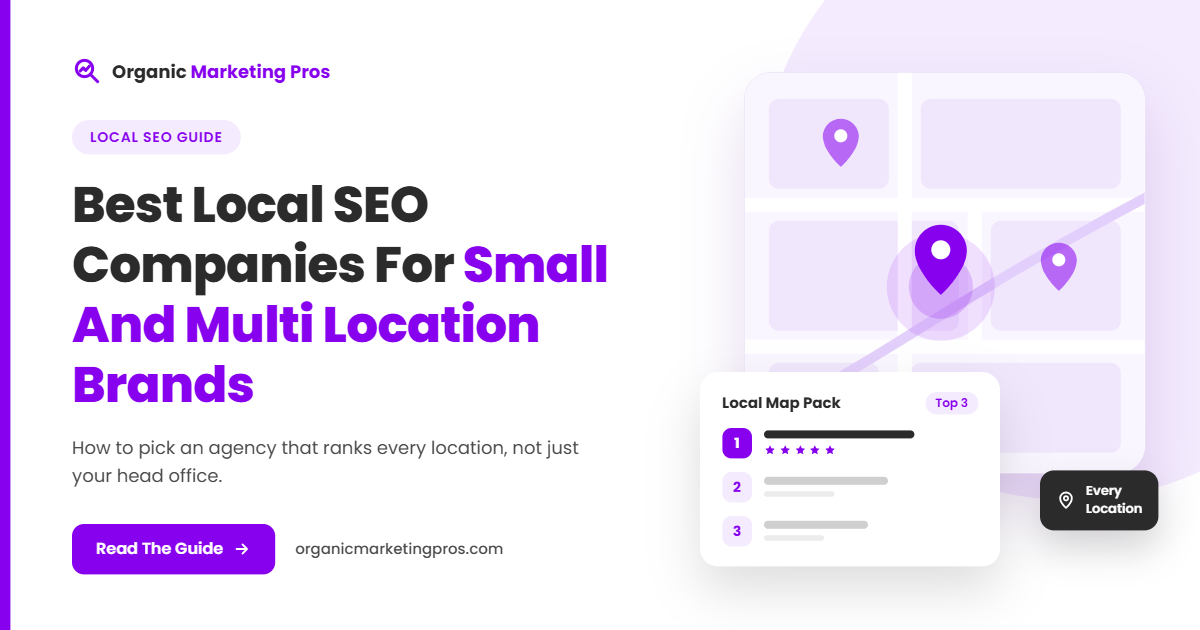
The best local SEO companies aren’t the ones at the top of a “best of” list. They’re the ones whose process fits your business: a single location shop needs someone who will fix its Google Business Profile, reviews and service pages, while a brand with 20 or 200 locations needs a team that can manage profiles in bulk, build location pages that aren’t copies of each other, and report results per location.
Whichever you are, the right company will tell you exactly what it does each month, let you keep ownership of your profiles and data, report calls and leads rather than just rankings, and never promise a guaranteed spot in the map pack. Below: the types of local SEO companies, what each kind of business needs, 12 questions to ask, and the red flags that should end the conversation.
How “Best Local SEO Companies” Lists Get Made
Before you trust any ranking, look at who wrote it. Several of the lists ranking on Google right now are published by agencies that include themselves near the top, and at least one says so openly. Others come from directories where placement can be influenced by reviews, profile completeness or paid features. None of that makes them useless, but it does make them a starting point, not a verdict.
A neutral directory such as the Semrush agency directory for local SEO is useful for building a shortlist, since you can filter by location, services, industry and budget, and read client reviews. Then judge every name on that list the same way, using the questions further down. That includes us.
The Types Of Local SEO Companies, And Who Each Fits
Local SEO companies come in very different setups. Picking the right type matters more than picking the right name.
Type | Best for | Strengths | Watch for |
Freelancer or consultant | One location, tight budget, owner willing to help | Direct access to the person doing the work, flexible | Capacity limits, holidays, no backup if they leave |
Local specialist agency | Single or few location service businesses | Focused on map pack, reviews and local pages; usually knows your market | May not handle paid ads, AI search or bigger technical work |
Full service agency | Businesses that also need ads, web or content | One team across channels and one report | Local SEO can become a small line item inside a big retainer |
Multi location specialist | Franchises and brands with 10 or more locations | Bulk profile management, location page systems, per location reporting | Minimum fees and longer onboarding |
Software platform (BrightLocal, Semrush Local and similar) | Teams that will do the work themselves | Listings sync, rank tracking, review monitoring at scale | A tool doesn’t write pages, earn links or make judgment calls |
Many businesses end up with a mix: software for listings and tracking, plus an agency or consultant for the work that needs judgment.
What A Small Business Needs From Local SEO Companies
If you have one or a few locations, the work that moves the needle is narrow and well known. Google says local results are based mainly on relevance, distance and prominence, and that more reviews and positive ratings can help. So a good company for a small business should cover:
- Google Business Profile setup: primary category, services, service areas, hours, photos
- Consistent name, address and phone details across your site and the directories that matter
- A review process you can actually run, with replies to every review
- Service pages with real detail, plus location pages only where there’s something true to say
- Local links and mentions from real sources in your area
- Tracking calls, direction requests and form leads, not just positions
We break each of these down in our guide to local search optimization for service businesses. If one of the local SEO companies you’re talking to sends a proposal that skips most of this list, ask why.
What Multi Location Brands Need That Small Businesses Don’t
Multi location SEO is a different job, and it’s where many local SEO companies built for single shops struggle. At scale, the problems are consistency, process and reporting.
Bulk profile management. Google offers bulk management for businesses with 10 or more locations, including uploading locations by spreadsheet and sharing access through business groups. A company working with a multi location brand should know this workflow, and how to handle verification and edits across dozens of profiles without errors.
Location pages that aren’t copies. Each location needs its own page with real local detail: address, hours, team, services offered there, reviews, directions, nearby areas served. Swapping the city name on one template creates thin pages that rarely rank. Ask to see how they build these at scale.
Per location reporting. A brand average hides problems. You need to see calls, direction requests, reviews and rankings for each location, so you can spot the three that are slipping while the other 40 grow.
Governance. Who approves profile changes? Who responds to reviews at each location? What happens when a franchisee edits their own profile? Good multi location SEO partners set these rules up front. For very large sites, the website side starts to look like enterprise SEO work: templates, crawl efficiency and migrations.
12 Questions To Ask Local SEO Companies Before You Sign
Question | A good answer | A red flag |
1. What will you do in the first 90 days? | A specific plan by month, starting with an audit | “We’ll optimize everything” |
2. Who owns the Google Business Profile? | You stay owner; they get manager access | They want to be owner, or create a new profile |
3. Who owns the website and content you create? | You do, in writing | It stays with them if you leave |
4. How do you choose the primary category? | Based on your services and what top competitors use | No clear method |
5. How do you get reviews? | A request process using your real customers | Buying, writing or filtering reviews |
6. Will you change our business name in the profile? | Only to match your real name | Adding keywords or cities to the name |
7. How do you build location pages? | Unique local detail on each one | One template with the city swapped |
8. What do you report each month? | Calls, leads, direction requests and rankings by area | Rankings only, from one search point |
9. How do you track rankings across our area? | A rank grid across your service area | “You’re number one” from their office |
10. How do you handle AI search for local queries? | Accurate listings, reviews and clear service pages | A secret AI trick |
11. What are the contract terms? | Clear notice period and exit terms | Long lock in with no exit |
12. Can we speak to a current client? | Yes, in a similar business | Only anonymous testimonials |
Question 10 matters more each year. Local searches increasingly get answered in AI Overviews and assistants, and the same groundwork (accurate listings, real reviews, clear service pages) feeds both. It’s why we run local and AI SEO together for clients who need both.
Red Flags That Should End The Conversation
Some local SEO companies still sell tactics that can get your profile suspended or put you on the wrong side of the law. Watch for these.
A guaranteed map pack position. Google says there’s “no way to request or pay for a better local ranking”. Anyone guaranteeing one is either misleading you or planning shortcuts.
Keywords added to your business name or a virtual office address. Both break Google’s Business Profile guidelines, and Google reserves the right to suspend profiles that violate them. A suspended profile drops out of the map pack completely.
Fake or bought reviews. Since 2024 this isn’t only a Google policy problem. The FTC’s final rule on fake reviews bans fake, AI generated and paid for sentiment reviews, and allows civil penalties against knowing violators. If an agency offers reviews as a deliverable, walk away.
Reports you can’t check. If you can’t see your own Search Console, analytics and Business Profile data, you can’t verify anything they tell you.
Choosing A Local SEO Company: A Worked Example
Here’s a hypothetical. The business and numbers are illustrative.
Say a dental group has 12 locations across two states. Three proposals arrive. A freelancer quotes a low monthly fee for “GMB optimization” across all 12. A full service agency offers a large retainer covering ads, social and SEO, with local SEO as one line. A multi location local SEO agency proposes bulk profile cleanup, a location page template filled with real detail for each clinic, a review request process for front desk staff, and a monthly report by location.
For a 12 location group, the third proposal is the one built for the actual problem, even if it isn’t the cheapest. The freelancer may be excellent, but 12 profiles, 12 pages and 12 review streams is a capacity problem for one person. The full service agency might be right if the group also needs ads, but only if local SEO gets named people and a named plan. Practices in healthcare also need reply rules for reviews that protect patient privacy, which is worth asking about directly; we cover that on our healthcare SEO page.
How We Approach It
We’d rather you judged us with the questions above than took our word for it. Our local SEO services start with an audit of your profiles, listings and pages, and report calls and leads by location.
Frequently Asked Questions
Q1: How Much Do Local SEO Companies Charge?
It varies with the number of locations, how competitive your market is and what’s included. Compare proposals by scope per location and what’s reported, not just the monthly fee, and ask what’s excluded.
Q2: Should I Hire A Local SEO Company In My Own City?
It helps if they know your market, but it isn’t required. Many strong local SEO companies work remotely, and process, ownership terms and reporting matter more than their office address.
Q3: How Long Before Local SEO Shows Results?
Profile fixes can show up in weeks once Google processes them. Reviews and local links build over months. Be wary of any company quoting a fixed timeline for a specific position.
Q4: Is A Local SEO Tool Enough Without A Company?
For listings and tracking, often yes, if someone on your team has time to act on it. Tools don’t write location pages, earn links or decide strategy; that’s where local SEO companies earn their fee.
Q5: Get A Proposal You Can Hold Us To
The fastest way to compare local SEO companies is to get proposals that answer the same questions.
Request a free custom proposal from Organic Marketing Pros and we’ll answer all 12 questions in writing, for your locations and your market.