Google ranking works in three stages. Google crawls pages, decides which ones to index, then uses a set of ranking systems to order the indexed pages for each search. Those systems weigh five things, in Google’s own words: what the searcher means, how relevant a page is, how trustworthy and high quality it is, how usable it is, and the searcher’s context, such as location.
That’s the honest version of Google ranking. Not 200 factors, and no secret formula. In practice, a handful of signals do most of the work: whether the page is indexed at all, whether it answers the query better than what already ranks, whether other sites vouch for it, and how people respond to it. Here’s how each one works, what Google has confirmed, and how to tell which one is holding your page back.
Most Google Ranking Problems Happen Before Ranking
Google describes its process in How Google Search Works: crawling, indexing, and serving results. Each stage filters out pages before the next one starts.
Stage | What happens | Where it goes wrong |
Crawling | Googlebot finds and fetches URLs through links and sitemaps | Pages blocked by robots.txt, orphaned from internal links, or buried too deep |
Indexing | Google processes the page and decides whether to store it | noindex tags, duplicates Google folds into another URL, pages it judges too thin to keep |
Ranking (serving) | Ranking systems order indexed pages for each query | Weak relevance, thin content, few links, poor user signals |
This matters because a page that isn’t indexed can’t rank, no matter how good it is. Before you worry about any Google ranking factor, open Search Console > Indexing > Pages and check that the page you care about is actually indexed. The Page indexing report tells you why if it isn’t. Our step by step SEO audit guide walks through that check in detail.
The Five Things Google Ranking Depends On
Google’s public explainer on how it determines ranking results names five broad factors. Every Google ranking signal hangs off these.
- Meaning: working out the intent behind the query, including spelling mistakes and synonyms.
- Relevance: whether the page matches that intent. Google says the most basic signal is a page containing the same words as the query, and that it also uses aggregated, anonymized interaction data to judge whether results are relevant.
- Quality: content that shows expertise, authoritativeness and trustworthiness, including whether other prominent sites link to or reference it.
- Usability: when other signals are roughly equal, pages that are more accessible and easier to use may perform better.
- Context: the searcher’s location, past search history and settings.
The same page also says Google never gives advertisers special treatment in how it ranks websites, and that nobody can pay for better ranking. Running Google Ads through a PPC management team can put you above the organic results, but it doesn’t move your organic position.
The Ranking Systems Behind Those Factors
Google also publishes a guide to its ranking systems, last updated December 2025. It’s the closest thing to an official list of Google ranking systems, and it’s much shorter than 200 items. The ones that matter for most business sites:
System | What Google says it does | What you can influence |
BERT, RankBrain, neural matching | Understand language, how words relate to concepts, and match queries to pages conceptually | Write naturally about the topic. Exact keyword repetition matters far less than covering what the searcher actually needs. |
Passage ranking | Identifies the relevant section of a page for a query | Clear headings with direct answers underneath, so a strong section can win even on a long page |
Link analysis and PageRank | Analyzes how pages link to each other to understand what they’re about and which may be most helpful | Earn links from relevant sites; build internal links to your important pages |
Reliable information systems | Surface authoritative sources and demote low quality content | Show who wrote it and why they know; cite sources; keep facts current |
Freshness systems | Show fresher content where it’s expected | Update pages on time sensitive topics with real changes, not new dates |
Reviews system | Rewards reviews with expert analysis and original research | If you publish product or service reviews, show firsthand testing |
Spam detection (SpamBrain) | Finds content that breaches Google’s spam policies | Avoid bought links, scaled thin pages and other tactics in Google’s spam policies |
Site diversity, deduplication | Usually limit results to two per site and remove duplicates | Don’t split one topic across several near identical pages |
The guide also lists retired systems, and one is worth knowing. The helpful content system, which triggered a wave of site wide drops after 2022, became part of Google’s core ranking systems in March 2024. It didn’t go away. Its signals are now baked into every core update, so there’s no longer a separate “helpful content update” to wait out.
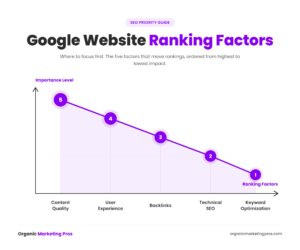
The 7 Google Ranking Factors That Matter Most, In The Order We Check Them
Here’s how those systems translate into the Google ranking factors we check on a page that won’t rank. The order matters: there’s no point building links to a page Google hasn’t indexed.
1. Indexing And Crawl Access
Covered above, and still the most common blocker. On very large sites, crawling itself becomes a constraint, which is where enterprise SEO work like crawl budget and log analysis comes in. Most sites under a few thousand pages never need to think about it.
2. Intent Match
Intent match is the Google ranking factor most people skip. Search your target query and look at what ranks. If the top ten are guides and your page is a service page, Google has already told you what it thinks the searcher wants. No amount of optimization makes a sales page rank for a “how to” query. This is the most overlooked factor in every list we’ve read, and it costs nothing to check.
3. Content Quality And Depth
Google’s helpful content guidance asks whether a page provides original information, research or analysis, and whether it adds substantial value compared with other pages in the results. In plain terms: if your page says the same thing as the nine pages above it, Google has no reason to put it first. Adding firsthand detail, real examples and clear answers is what moves pages, and it’s the core of what our content marketing team produces for clients.
4. Links From Other Sites
PageRank is still an active system, and links are still one of the clearest Google ranking signals of quality. But count matters much less than relevance. Ten links from sites in your industry beat a hundred from unrelated directories, and bought links fall under Google’s spam policies.
5. User Interaction Signals
For years Google was cagey about whether clicks affect rankings. Its own explainer now says it uses aggregated, anonymized interaction data to assess relevance. In 2024, leaked internal documentation that Google confirmed was authentic referenced a system called NavBoost that uses click data, along with a site level authority attribute. Google warned against drawing conclusions from “out of context, outdated, or incomplete information”, and it’s right that nobody outside knows the weights.
The practical takeaway is the same either way. Titles that earn the click, pages that answer the question fast, and content people don’t immediately bounce back from are good for rankings. Trying to fake clicks isn’t.
6. Page Experience
Core Web Vitals and mobile usability matter for Google ranking, but mostly as a tiebreaker. Google says good Core Web Vitals align with what its ranking systems reward; it doesn’t claim they’ll lift weak content. Check Search Console > Experience > Core Web Vitals and fix failing templates that contain your money pages. Chasing a perfect PageSpeed score on a page with no links and a vague answer is time spent in the wrong place.
7. Context: Location And Personalization
For “near me” and service searches, location changes everything. The same query from two parts of a city can return different results, and the map pack runs on its own mix of relevance, distance and prominence. If most of your customers find you locally, local SEO is a different discipline from ranking a national blog post.
Core Updates: Why Rankings Move When You Changed Nothing
Google ranking shifts most visibly during core updates, when Google adjusts its core systems. That happens several times a year. Its Search Status Dashboard lists them: core updates started in March, June and December 2025, then March 27 and May 21, 2026, each rolling out over roughly 12 to 18 days, alongside separate spam updates.
A drop during a core update doesn’t mean you were penalized. It means Google reassessed which pages best answer those queries, and something else won the comparison. The fix is almost never technical. Compare your page with what now outranks it and ask what it offers that yours doesn’t. Then give it time: changes after a core update often only show after the next one.
What Doesn’t Affect Google Ranking (Despite What You’ve Read)
Claim | What Google actually says |
E E A T is a ranking factor | Google says E E A T itself isn’t a specific ranking factor. Its systems use a mix of signals that identify content with good E E A T, with extra weight on health, finance and safety topics. |
Quality raters decide your rankings | Rater data isn’t used directly in ranking algorithms. Google compares it to feedback cards used to check whether its systems work. |
Longer content ranks better | There’s no ideal word count. Google’s guidance warns against writing to a length you think it prefers. |
An exact match domain gives you a boost | Google runs a system specifically to stop exact match domains getting extra credit just for the name. |
Buying Google Ads helps organic rankings | Google says nobody can pay for better ranking, advertisers included. |
You need special tricks for AI Overviews | Google’s May 2026 guide says its AI features are rooted in the same core ranking systems. Good SEO is the AI Overviews strategy. |
That last point is why we treat AI SEO as an extension of ranking work rather than a separate channel. Google’s guide to generative AI features says the same thing.
How To Figure Out Which Google Ranking Factor Is Holding Your Page Back
Start from the symptom, not a checklist of Google ranking factors. Search Console tells you which situation you’re in.
Symptom | Most likely cause | Where to check |
Page gets no impressions at all | Not indexed, or no clear query match | Pages report and URL Inspection tool |
Impressions but stuck at positions 11 to 30 | Intent mismatch, weaker content or fewer links than the top ten | Performance report: filter by page, then compare the queries with the pages that outrank you |
Good positions but low clicks | Title and description don’t earn the click, or an AI Overview answers above you | Performance report: CTR by query |
Sudden drop on a core update date | Competitors now judged more helpful for those queries | Performance report compared across the update dates on Google’s status dashboard |
Drop across the whole site overnight | Technical: noindex, robots.txt, migration or a manual action | Pages report and Security & Manual actions |
If you work through this and the answer is “the pages ahead of us are simply better”, you’re looking at a content and authority gap, not a quick fix. That’s the work our SEO services are built around.
Frequently Asked Questions
Q1: How Many Google Ranking Factors Are There?
Google doesn’t publish a number of Google ranking factors. Its ranking systems guide lists fewer than twenty named systems, each combining many signals. The “200 factors” figure is an old industry estimate, not an official list.
Q2: What Is The Most Important Google Ranking Factor?
For a page that’s already indexed, relevance to the searcher’s intent is the Google ranking factor that comes first. A page that doesn’t match what the searcher wants won’t rank however many links it has.
Q3: How Long Does It Take To Rank On Google?
It depends on the competition, the site’s existing authority and what needs fixing. Technical fixes can show once pages are recrawled. New content and links usually take months, and core updates can reset positions in between.
Q4: Does Google Use Clicks To Rank Pages?
Google says it uses aggregated, anonymized interaction data to help assess relevance. Leaked documents in 2024 referenced a click based system called NavBoost. The exact weight isn’t public.