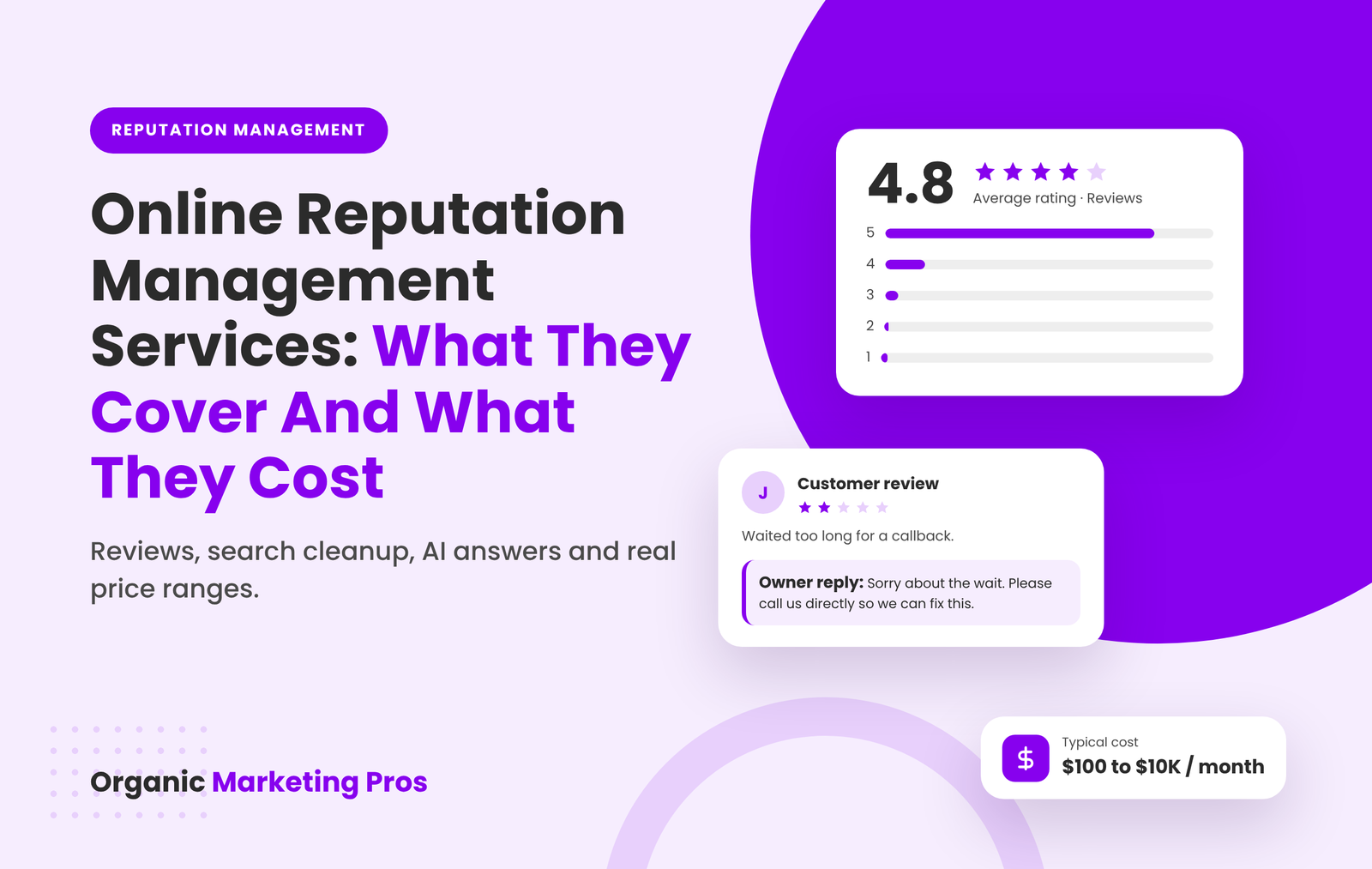
Online reputation management services help a business shape what people see when they look it up: reviews on Google and other sites, the first page of search results for its name, social mentions and, increasingly, what AI assistants say about it. Most plans cost somewhere between $100 and $10,000 a month, depending on how many locations you have and whether you need routine review management or a serious cleanup of damaging search results.
What no legitimate service can do is delete truthful negative reviews, buy fake positive ones, or make a news article disappear on request. Below: what ORM work actually includes, what it costs, what the law and Google’s rules forbid, and how to choose a provider.
What Online Reputation Management Services Actually Cover
Most online reputation management services combine five kinds of work. Small businesses usually need the first two; brands with a specific problem need the rest.
Review Generation And Response
This is the core of ORM for most businesses. Google says that more reviews and positive ratings can improve your local ranking, so a steady flow of genuine reviews helps both reputation and visibility. It’s also why review work sits so close to local SEO services.
What A Good Review Request Looks Like
A short message sent right after the job or visit, with a direct link to your review form, sent to every customer rather than only the happy ones. Asking everyone keeps you on the right side of the law, as the FTC rule section below explains. Our guide to local search optimization covers how to build this into your routine.
How To Reply To A Negative Review
Reply quickly, calmly, and briefly. Acknowledge the experience, avoid arguing details in public, and offer a direct way to resolve it offline. Future customers read the reply more closely than the complaint.
Monitoring And Alerts
Monitoring tools watch review sites, social platforms, forums, and news for mentions of your brand, so you can respond in hours instead of weeks. For most small businesses, alerts on Google reviews and your main industry review site cover the risk. Good online reputation management services set this up in the first week.
Search Results Cleanup
When a damaging page ranks for your name, the realistic fix is usually not removal but replacement: building strong, accurate pages that outrank it. That means your own site, profiles on trusted platforms, interviews, press coverage and helpful content. This is SEO work at heart, and it overlaps with ongoing SEO services and content marketing. It takes months, not days, because you’re asking Google to prefer better pages, and the usual ranking factors still apply. Be wary of online reputation management services that promise faster results.
While that work runs, some brands also run paid search on their own brand name so the first thing people see is a message they control.
Removal Requests: What Can And Can’t Come Down
Some content can be removed through official channels. Most negative content can’t, and you should be wary of anyone who says otherwise.
Google Reviews That Break Policy
Google says only reviews that violate its policies are eligible for removal, and tells businesses not to report a review “just because you disagree with it or dislike it.” You can flag spam, conflicts of interest, harassment or off topic reviews through your Business Profile or the Reviews Management Tool. Evaluation typically takes several days, and you get one appeal if the review stays.
Personal Information In Search Results
Google’s Results about you tool lets people request removal of search results showing their phone number, home address or email. Google notes the information still exists on the source website, so the site owner has to remove it there too.
What AI Answers Say About Your Brand
People now ask ChatGPT, Google’s AI Overviews and other assistants “Is this company any good?” Those answers summarize what reviews, forums and articles say about you. Accurate, consistent information across your site, profiles and the sources AI cites is now part of reputation work. Our AI SEO services cover this, and our guide to evaluating a GEO agency explains how to check it yourself.
What Online Reputation Management Services Cost
Published Price Ranges
One large agency’s reputation management pricing guide puts most plans between $100 and $10,000 a month, or $151 to $5,000 per location. That’s a vendor’s figure and a very wide range, which is exactly why scope matters more than the headline price when you compare online reputation management services.
What Pushes The Price Up
- Number of locations and review platforms to monitor and respond on
- Response volume, especially for brands with hundreds of reviews a month
- Search results cleanup, which needs content, PR and SEO work over many months
- Urgency, such as a crisis that needs daily monitoring and senior attention
- Regulated industries that need compliance review before anything is published
What Each Budget Typically Covers
These are illustrative scopes, not OMP prices:
| Monthly budget | Usually covers | Usually doesn’t |
| Under $300 | Review monitoring software, request automation, basic reply templates | Hands on replies, search cleanup |
| $300 to $1,500 | Managed review requests and replies, profile upkeep, monthly reporting for one to a few locations | Suppressing damaging search results |
| $1,500 to $5,000 | Multi location review management, social monitoring, content and SEO to strengthen branded results | Crisis response at scale |
| $5,000+ | Search results cleanup, PR, executive reputation, crisis monitoring | Guaranteed removals (no one can) |
When comparing quotes, use the same approach as for any SEO proposal: check diagnosis, scope, reporting, ownership and terms. Our guide to choosing an SEO company for a small business includes a scorecard that works for ORM proposals too.
What Reputation Management Can’t Legally Do
The FTC Rule On Fake Reviews
In August 2024 the FTC announced a final rule banning fake reviews and testimonials, which took effect on October 21, 2024. It allows civil penalties against knowing violators.
What The Rule Bans
According to a legal summary of the rule, it prohibits:
- Writing, buying or selling reviews that misrepresent who the reviewer is or their experience
- Offering rewards for reviews of a particular sentiment, such as a discount for a five star rating
- Review suppression: using unfounded legal threats, intimidation or false accusations to stop or remove reviews
- Undisclosed reviews from employees or close relatives, where the connection is material
- Company controlled “independent” review sites
- Buying fake followers or other fake social media indicators
The suppression point matters for ORM. A provider that threatens reviewers with lawsuits to get reviews taken down can put your business at legal risk.
Google’s Review Rules
Google’s policies also ban fake engagement, review gating (only asking happy customers) and incentives for reviews. Breaking them can get reviews removed or restrictions placed on your profile, which is why our guide to choosing a local SEO company lists fake reviews as a reason to walk away.
How To Choose An Online Reputation Management Company
Questions To Ask Before You Sign
Put these questions to every provider of online reputation management services you’re considering, and compare the answers side by side.
| Question | A good answer | A red flag |
| What exactly will you do each month? | Specific tasks, platforms and response times | “We manage your reputation” |
| How do you get reviews? | Requests to every real customer | Incentives, gating or writing reviews |
| What can you get removed? | Only policy violating content, through official channels | “We can remove any review” |
| How will you handle a damaging search result? | Build better pages over months, with a plan | Guaranteed removal in days |
| Who writes review replies? | A named person, with your approval rules | Unchecked automation |
| What do you report? | Rating trend, review volume, response time, branded search results | Vanity sentiment scores only |
Red Flags
- Guaranteed removal of negative reviews or articles
- Offers to post reviews for you or “seed” reviews from staff
- Legal threats against reviewers as a standard tactic
- Long contracts with no clear deliverables
- Reports you can’t check against your own Business Profile data
Reputation Management By Industry
Healthcare Practices
Replying to patient reviews is risky: even confirming someone is a patient can breach privacy rules. Keep replies general and move details offline. We cover this in our healthcare SEO work.
Law Firms
Reviews heavily influence how people choose a lawyer, and state bar advertising rules can limit how testimonials are used. Check your bar’s rules before featuring reviews, and see how law firm SEO ties reviews to local visibility.
Multi Location Brands
With dozens of locations, the challenge is consistency: one brand voice, clear rules on who replies, and reporting by location so problem branches stand out. On large sites this overlaps with enterprise SEO governance.
A Worked Example: What A Plan Might Look Like
A hypothetical, with illustrative numbers. Say a two location dental practice has a 3.9 star rating, 40 reviews, and an old complaint thread ranking third for its name. A sensible plan would be: a review request process for every patient (month 1), privacy safe reply templates (month 1), flagging any reviews that clearly break Google’s policies (month 1), then strengthening branded results with an updated website, complete profiles and two or three helpful articles (months 2 to 6). Success would be measured by rating trend, review volume, and where the complaint thread ranks for the brand name over time, not by a promise to delete it.
Frequently Asked Questions
Q1: Can A Reputation Management Company Remove Bad Reviews?
Only reviews that break the platform’s policies, such as spam or harassment, through official reporting. Truthful negative reviews stay; the answer is better replies and more genuine positive reviews.
Q2: How Long Does Online Reputation Management Take?
Review improvements can show within weeks. Pushing a damaging result down in search usually takes several months of consistent work.
Q3: Is Reputation Management Worth It For A Small Business?
Usually yes for the basics. Entry level online reputation management services cover a review request process and timely replies. Most small businesses don’t need expensive search cleanup unless there’s a specific damaging result.
Q4: Does Reputation Affect SEO?
Yes, for local search. Google says reviews and ratings can affect local ranking, and reviews influence whether people click and call.